The human and the geological time horizons
Past resembles distance; our view there becomes unreliable und loses itself, if not history and chronology had set up beacons, torches at the most obscure places; but despite those lights of written tradition, going back several centuries, which uncertainties concerning the facts, which errors about the causes of events and which profound obscurity does not surround the times before that Tradition!
Georges-Louis Leclerc de Buffon (Learn more)
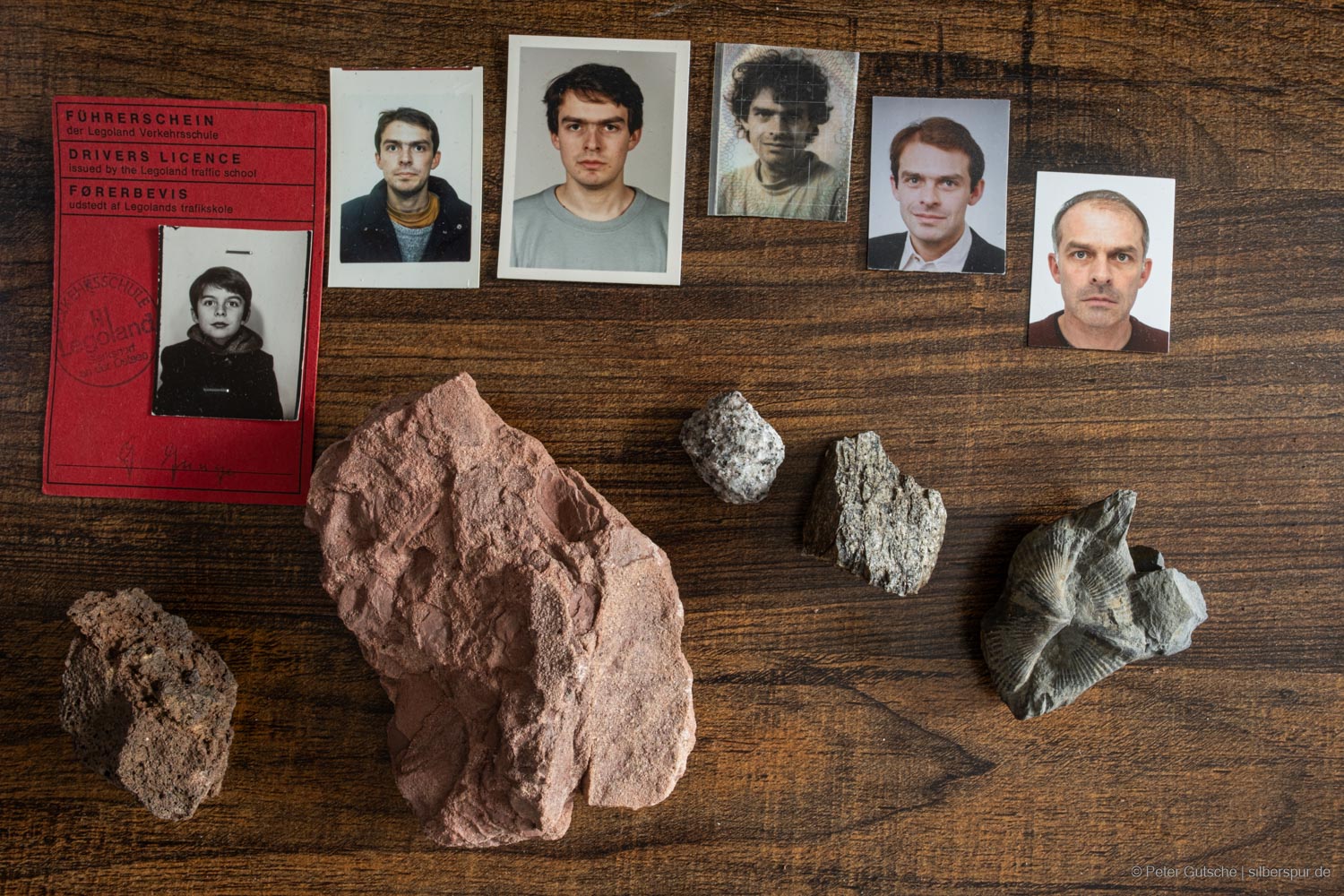
The contrast shown in the photograph between different time scales – the human timescale and the time scale on which the 'life' of rocks takes place – serves as a prelude to the topic of this text. In a multi-part series, I would like to approach, step-by-step, an understanding of the different time scales on which, at one end, human life, and, at the other end, the history of Earth takes place.
In this blog post, I first provide a brief philosophical classification of the topic. In the second blog post, we deal with landscape changes in prehistoric and historical times. In the third blog post, we get to know lakes in the Black Forest and the Vosges as geological archives. On June 19, 2026, there was a lecture at the Atelier Klausenpfad in Heidelberg (in German; covering the content of the first three blog posts).
Hans Blumenberg’s 'Weltmißbefinden'
Our life inevitably takes place in time. We think, speak, feel, move – indeed, we exist in this „medium“ like a fish in water. We cannot take ourselves out of time.
And yet, as mortal beings, we 'have' only a limited amount of time.
The German philosopher Hans Blumenberg (1920 – 1996) has expressed this in a smarter way (Learn more):
Time is the most ours, but the least available.
Hans Blumenberg talks about a mental state 'Weltmißbefinden' – which can be translated to world-discontent – when he tries to grasp the following primordial human experience („Ur-Erfahrung“):
Within a single human life, only a tiny part of what the world as a whole has to offer can be experienced. When we are born, the world exists already and many things have already happened without our participation. When we die, the world continues to exist and those living after us will have experiences that are denied to us.
According to Blumenberg, since the Fall of Man – the realization of our mortality – a gap yawns between the 'Lebenszeit' (lifetime) – the limited span of a human life – and the 'Weltzeit' (world time) – the time that is available to the world as a whole. (Learn more)
Horizons of memory
With our personal memory, we explore the area within the horizon of our lifetime. Memory takes us back to some more or less clear impressions from our childhood, which are placed like „beacons“ at the edge of a darkness, in the depths of which our birth must have occurred somewhere. But the more we try to focus on an event far in the past, the more that picture – which had started to become apparent – blurs.
For example, I think of a day during my childhood when we were on vacation in the mountains. We hiked to a nearby village. Maybe I was 4 years old or so. I see the silhouettes of farmhouses with their big roofs. And I realize a wooden stick I used to scratch a line into the gravel walk. Only this detail has been preserved. The image does not become any clearer. My personal memory reaches a limit here.
When parents talk with their children about experiences far in the past, the collective remembering creates a story of what supposedly happened once. This story is told – and changed – again and again. Personal and collective memory complement each other; the boundaries sometimes blur. Documents like old letters and photographs can act as reference points that help to fix this narrative.
An interesting perspective arises from the time span during which a single human can be connected with other humans through direct generational succession. The Icelandic writer Andri Snær Magnason presents this perspective powerfully in his book On Time and Water. The author’s daughter can still have a personal connection to her great-grandmother and (possibly later in her own life) to her great-grandchildren – a time span of about 260 years. This means that for a single human being, the time span of a quarter millennium is tangible. (Learn more)
The historical memory covers a significant larger period. A possible point of reference is the invention of writing. Cuneiform, which developed from pictorial signs, is first attested for the 4th millennium BC. The alphabet script emerged around 1700 BC on the Sinai Peninsula.
Human knowledge was also carried on from generation to generation by oral tradition. Already thousands of years ago, sailors in the Pacific used sophisticated navigational techniques to travel securely between the widely separated islands of Micronesia and Polynesia. These techniques were based on the knowledge of the rising and setting of bright stars on the horizon and also included the observation of the behavior of birds, ocean waves, and wind patterns. These skills were handed down orally from generation to generation, though it is unknown exactly when this tradition began. (Learn more)
Archaeological finds provide evidence of much earlier epochs of humanity. However, what early humans thought or felt can hardly be derived from these artifacts – if at all.
Like personal memory, humanity’s collective memory trails away in a darkness, and our gaze would disappear completely – as Buffon expressed so nicely – 'if not history and chronology had set up beacons, torches at the most obscure places'.
Time of Earth – the abyss of time
This means, also for humanity there’s a time 'before' and a time 'after'.
There was a time in Earth’s past when humans as a species did not yet exist, and, possibly, there will be a time when humans have disappeared from Earth's surface.
Geological processes happen on those time scales that come into view here. Mountains form and are eroded away again, continents change their position. But these changes take place on time scales beyond our human time horizon – outside the range that is accessible to our personal, familial, or even our historical memory.
Although we, as abstract-thinking beings, can deal with the parameter of time in scientific equations as a matter of course, it is hard for us to translate such slow processes as the rise and erosion of mountains into our everyday understanding, or to build a relationship with this knowledge.
I can observe that every time during a rainfall a little bit of soil eroded from a slope or how during an extreme weather event a street is spilled by an earthslide. I can try to imagine what happens when such events repeat themselves over millennia. Nevertheless, long-term processes such as the transformation of a landscape relief elude a deeper understanding. They can be accessed neither through perception, memory, nor through tradition. They belong to the 'profound obscurity' of which Buffon spoke.
He used – like other natural philosophers of the Enlightenment – metaphors from the historical sciences to describe the evolution of Earth, the history of Earth. In his theory, he divided this history into seven epochs. In the last epoch, man appears.
Buffon formulated his ideas at a time when large parts of society assumed that the age of the Earth was about 6000 years – a number that was given by biblical chronologies. However, many natural philosophers of the time who dealt with strata or fossils assumed that there must be geological processes that take significantly longer than just a few millennia – so did Buffon.
He developed a theory according to which the Earth was initially a hot, molten sphere. With the equations of early thermodynamics he calculated how long it took until Earth had cooled down to today’s temperatures. On his estate in Montbard, Burgundy, France, he made experiments with heated metal spheres in order to determine cooling rates for solid bodies. (Learn more) Based on these considerations and experiments, he estimated the age of the Earth at about 75 000 years.
It is interesting to note that Buffon was among the first to assume that humans are able to cause a change in the Earth's climate. Since in his model the Earth was inexorably cooling down, from his perspective it was – unlike the consensus today – considered desirable that humans did everything in their power to counteract the cooling – for example, by burning coal. (Learn more)
The dicovery of radioactive decay end of the 19th century made it possible to develop modern dating methods. With their help, in the 1950s, the age of the Earth was estimated at 4.54 billion years. (Learn more) That is 60 000 times longer than Buffon had estimated.
With this knowledge, we rate ourselves superior to the natural philosophers of earlier centuries. However, the pure number with 10 digits doesn't help us grasp this immense span of time. We find ourselves, in the truest sense, face to face with an abyss of time which should make one humble.
To emphasize the challenges posed to us by such long geological time spans, the term deep time was established. The determiner 'deep' holds a poetical dimension and refers to a domain that is detracted from human comprehension.
The palaeontologist Stephen Jay Gould asserts that we can comprehend deep time only as a metaphor (Learn more):
An abstract, intellectual understanding of deep time comes easily enough – I know how many zeroes to place after the 10 when I mean billions. Getting it into the gut is quite another matter. Deep time is so alien that we can really only comprehend it as metaphor.
Approaching deep time – the retrospective narrative mode
With this text, I’d like to approach an understanding of deep time step-by-step. It seems obvious, when writing a popular science text that deals with cosmology or Earth history, to start from a presumed initial point – typically, the Big Bang – and to work one's way forward from there through the past up to the present. This narrative mode suggests an omniscient narrator who surveys those immense periods that this „world narrative“ is about.
I instead adopt a more modest perspective by using a retrospective narrative mode: starting from the human time perspective familiar to us, the reader is guided step-by-step deeper into the past, toward ever larger time scales and ever more unfamiliar terrain. (Learn more)
From this perspective, initial – comparatively rapid – geological changes soon become perceptible: changes in vegetation, shifting of river courses, and the development of lakes. These processes happen slowly from a human perspective – they cannot be perceived even on the time scale of several human generations. However, they produce visible changes already within historical time spans. In a next step, we compress the time scale step-by-step so that long-term processes like mountain building or continental drift become visible.
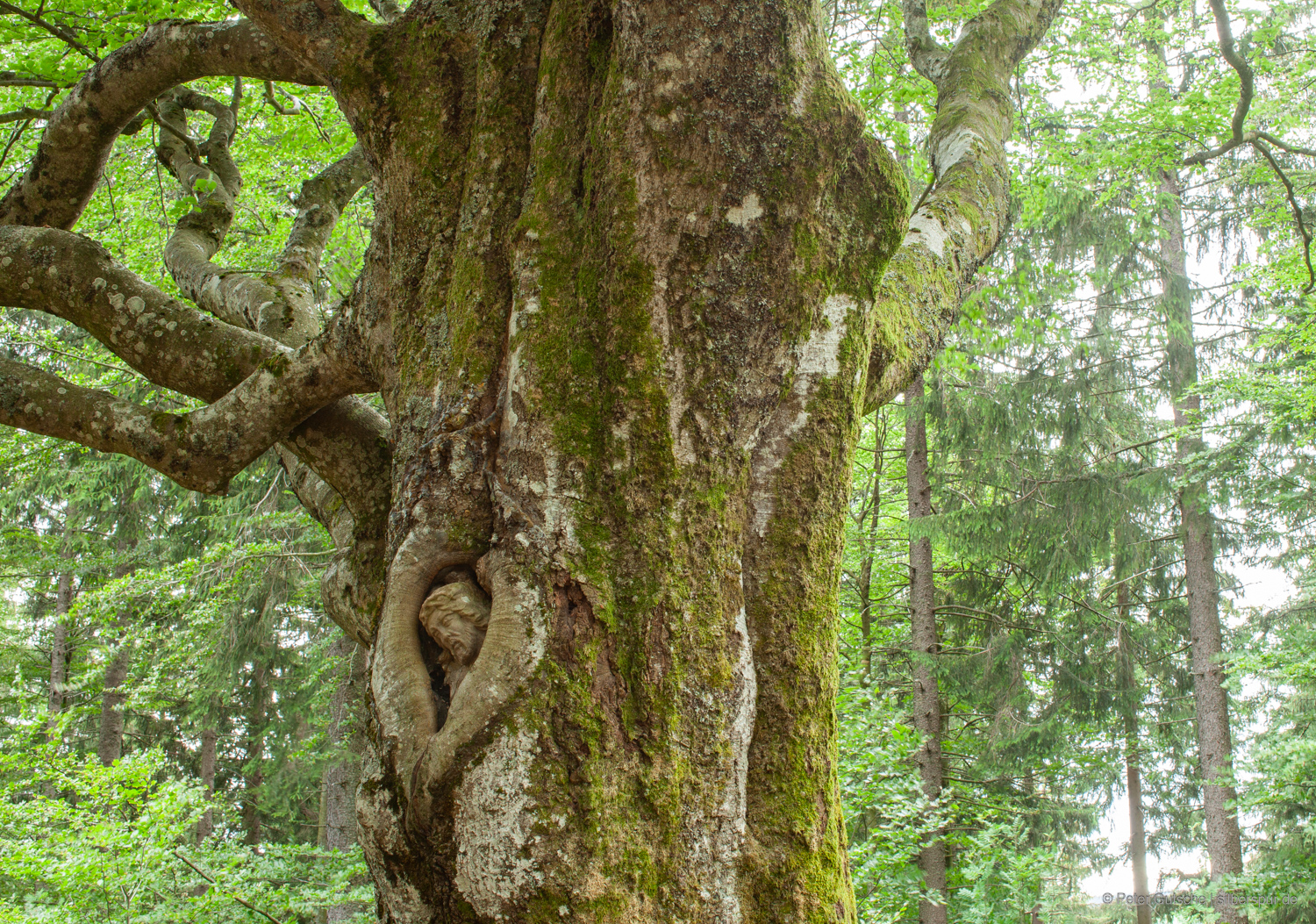
A historical-literary reference – the Mummelsee episode in the works of Grimmelshausen
To begin discussing changes to Earth’s surface that occur relatively quickly compared to geological time scales, I’d like to tell you the story of a few small lakes in the Black Forest and the Vosges – mountain ranges in Germany and France. These lakes formed at the end of the last ice age in depressions created by retreating glaciers. These terrain formations are called cirques. Consequently, the lakes are referred to as cirque lakes.
One of these cirque lakes is even referenced in world literature.
In the picaresque novel The adventurous Simplicissimus, written by Hans Jakob Christoffel von Grimmelshausen (1622 – 1676) and published in 1668, the protagonist undertakes an excursion to this remote location, that was accessible in the 17th century exclusively by a lengthy march.
Let’s begin our journey into the depths of Earth’s past within the realm of historical memory. To do so, let’s mentally transport ourselves to the 17th century – to a time that seems foreign to us today in many ways. We will read a short excerpt from the novel. (Learn more)
So together we set off over hill and dale and came to the Mummelsee; and that before we had gone six hours, for my dad was as lively as a cricket and as good a traveller as any young man. And there we consumed what meat and drink we had brought with us, for the long journey and the high mountain on which the lake lieth had made us both hungry and thirsty. So having refreshed ourselves I did inspect the lake, and found lying in it certain hewn timbers which my dad and I took to be the remains of the Würtemberg raft : and I by geometry took or estimated the length and breadth of the water (for 'twas far too wearisome to go round the lake and measure it by paces or feet), and entered the dimensions, by means of the scale of reduction, in my tablets. And having done this, the sky being completely clear and the air windless and calm, I must needs try what truth was in the legend that a storm would arise if any should throw a stone into the lake; having already found those stories I had heard, how the lake would suffer no trout to live in it, to be true, by reason of the mineral taste of the waters.
The text contains some interesting details, for example, 'the remains of the Würtemberg raft', which point to the fact that this lake was not as isolated from human activity as it might seem at first glance.
The photograph shows the Mummelsee in the year 2006. Today, the lake lies on the busy Black Forest High Road, with a hotel on its shore.
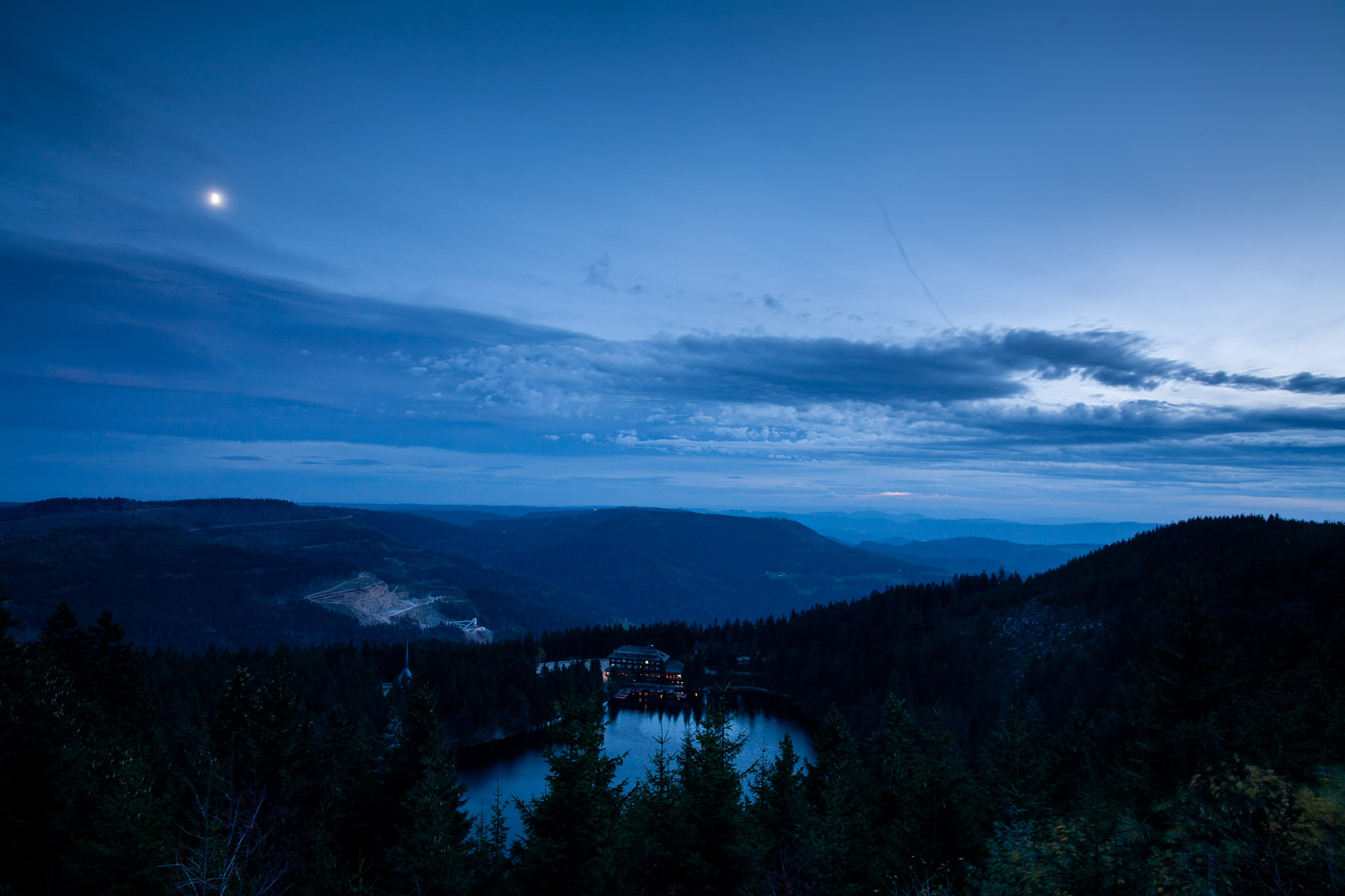
Mummelsee is perhaps the most popular glacier cirque lake in the Black Forest. However, there are others: the Black Forest and the Vosges together have about 30 such lakes. (Learn more)
In the next blogpost, we visit these lakes and learn about their history.
Bibliography
- Blumenberg, H., 2016. Lebenszeit und Weltzeit, 5. Auflage. ed, Suhrkamp-Taschenbuch Wissenschaft. Suhrkamp, Frankfurt am Main.
- Buffon, Georges Louis Leclerc, comte de, 1780. Les Époques de la Nature. URL
- Dalrymple, G.B., 1991. The Age of the Earth. Stanford University Press, Stanford, Calif.
- Dawkins, R., Wong, Y.-L., 2016. The Ancestor’s Tale: a Pilgrimage to the Dawn of Evolution, Revised and expanded/Second Mariner Books edition. ed. Houghton Mifflin Harcourt, Boston New York.
- Fezer, F., 1957. Eiszeitliche Erscheinungen im nördlichen Schwarzwald. Selbstverlag der Bundesanstalt für Landeskunde. URL
- Franziskus, 2013. Evangelii Gaudium (Apostolic Exhortation on the Proclamation of the Gospel in Today's World). URL
- Gould, S.J., 1987. Time’s Arrow, Time’s Cycle: Myth and Metaphor in the Discovery of Geological Time, The Jerusalem-Harvard Lectures. Harvard University Press, S.l.
- Grimmelshausen, H.J.C. von, 1912. The adventurous Simplicissimus : being the description of the life of a strange vagabond named Melchior Sternfels von Fuchshaim. URL
- Grimmelshausen, H.J.C. von, 2018. Simplicissimus Teutsch, 5. Auflage. ed, Deutscher Klassiker Verlag im Taschenbuch. Deutscher Klassiker Verlag, Frankfurt am Main.
- Heringman, N., 2016. Buffons Époques de la Nature (1778) und die Tiefenzeit im Anthropozän. Zeitschrift für Kulturwissenschaften. URL
- Lewis, D., Oulton, D., 1994. We, the navigators: the ancient art of landfinding in the Pacific, 2nd ed. ed. University of Hawaii press, Honolulu.
- Magnason, A.S., 2025. Wasser und Zeit: eine Geschichte unserer Zukunft, 2. Aufl. ed, Insel-Taschenbuch. Insel Verl, Berlin.
- Martins, K., 2020. Polynesian Navigation & Settlement of the Pacific: Migration in Oceania. World History Encyclopedia. URL
- Schwarzbach, M., Wolstedt, P., 1967. Eiszeitalter und Gegenwart: Jahrbuch der Deutschen Quartärvereinigung. Hohenlohe’sche Buchhandlung Ferd. Rau, Öhringen, Württemberg. URL
- Wyse Jackson, P.N., 2006. The Chronologers’ Quest: Episodes in the Search for the Age of the Earth. Cambridge university press, Cambridge.
Related Entries


